

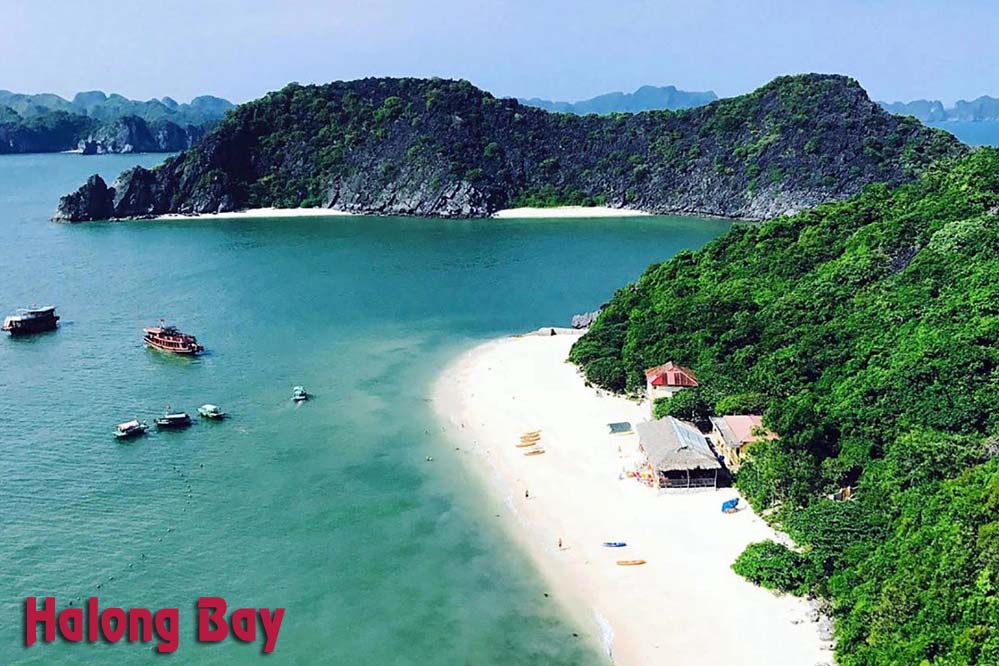
Yen Tu, Con Son, Kiep Bac, Halong Bay, Cat Ba, and other heritage sites
are paving the way for new collaborative development in tourism for both
Quang Ninh and Hai Phong. This partnership goes beyond mere promotion; it
involves the systematic creation of itineraries featuring specific products,
services, and experiences. -
Halong Bay travel
Recently, at the Con Son - Kiep Bac Festival (September 26, 2026), a unified
brand identity was unveiled for the World Heritage complex comprising Yen
Tu, Vinh Nghiem, Con Son, and Kiep Bac. Featuring an image of a
chrysanthemum flower set within a bodhi leaf-accompanied by the message
"Wisdom - Harmony - Spreading Influence"-this initiative represents a
cohesive promotional strategy for these cross-provincial heritage sites.
More importantly, these historic landmarks, which visitors previously
explored individually, are now being integrated into a shared, unified
journey.
Recognized by UNESCO in 2025, this heritage complex-spanning Quang Ninh, Hai
Phong, and Bac Ninh-is deeply linked to the history of the Tran Dynasty and
the Truc Lam school of Buddhism. These shared assets offer significant
potential for developing inter-regional cultural and spiritual tourism.
According to Nguyen The Hue, Chairman of the Quang Ninh Tourism Association,
tourism associations are strengthening their cooperation by encouraging
businesses to survey routes, develop tourism products, connect visitor
networks, and conduct joint promotional activities. These efforts aim to
diversify visitor experiences and enhance the overall competitiveness of
tourism in the region.
To formalize this collaboration, in April 2026, tourism associations and
businesses from the three localities signed a memorandum of understanding
for the 2026-2028 period, centered on the concept: "One Journey - Three
Heritage Destinations". Building on the collaborative initiatives
established in 2023, the involved parties are working together to conduct
surveys, develop products, promote offerings, and explore joint strategies
to stimulate tourism demand.
In practice, several products have already been launched. Hai Phong has
introduced three heritage-focused tours, including an itinerary that links
Con Son, Kiep Bac, Thanh Mai, Kinh Chu, and Nham Duong. In Quang Ninh, sites
such as Yen Tu, Ngoa Van, Thai Mieu, and Bach Dang can be integrated into
inter-regional programs. Beyond religious pilgrimage and historical
exploration, these routes can also incorporate culinary experiences,
overnight stays, and cultural immersion. However, to effectively attract
visitors, businesses must reach a consensus on departure schedules, pricing,
pickup locations, and operational management.
More importantly, each itinerary should be anchored by a cohesive narrative.
Yen Tu is intrinsically linked to the origins of the Truc Lam Zen school;
Con Son is associated with the school’s founding patriarchs; and Kiep Bac
bears the legacy of the great commander Tran Quoc Tuan (Hung Dao Dai Vuong).
Weaving these narratives into guided commentary and visitor experiences will
add depth to the offerings, encouraging travelers to explore multiple
heritage sites within a single trip.
While inter-regional cultural itineraries continue to be refined,
cooperation between Halong Bay and the Cat Ba Archipelago has already
yielded tangible results. Following the expansion of the UNESCO World
Heritage site designation in 2023, Quang Ninh and Hai Phong have
collaborated to resolve management challenges and establish interconnected
sightseeing routes. Starting in April 2026, cruise itineraries between
Halong Bay and Lan Ha Bay will officially commence operations. Accordingly,
four inter-regional itineraries have been licensed, with businesses
beginning operations on select routes. Visitors can combine visits to Cua
Van, Tien Ong Cave, and Ba Ham Lake with destinations such as Sang Toi Cave,
Tra Bau, and Viet Hai village-engaging in activities like kayaking, cave
exploration, and learning about local fishing communities, or opting for
overnight stays on cruise vessels. The landscapes of Halong and the tranquil
charm of Lan Ha complement one another, enriching the overall visitor
experience.
The collaboration surrounding these heritage sites is gradually evolving
from formal agreements into tangible tourism products. In the first two
months following the launch of the integrated Halong-Lan Ha routes (between
April and June 2026), the services accommodated 4,562 visitors and generated
over 1 billion VND in revenue. Two cruise vessels operated by Bhaya Cruises
on the Halong-Lan Ha route achieved an average cabin occupancy rate of
60-70% after just over a month of operation.
However, joint development also necessitates a commitment to conservation.
Both localities must coordinate on vessel management, search and rescue
operations, waste control, and the monitoring of carrying capacity, while
also sharing visitor data. Regarding cultural heritage, such collaborations
must respect the existing landscapes, traditional rituals, and the lives of
local communities, ensuring that commercialization does not proceed
unchecked.
From established maritime routes to emerging cultural itineraries, Quang
Ninh and Hai Phong are expanding the scope of their heritage-based tourism.
As products, services, and management frameworks become more seamlessly
integrated, these heritage assets will serve as a driving force for
sustainable tourism development in both regions.
Source:
New heritage itineraries linking Quang Ninh and Hai Phong


